
International projects
What to Verify Before Approving an International Project
Seven verification gates for owners and investment committees: title and cost recovery, counterparties, payment and repatriation, enforceability, execution, security and exit.
Key findings
Verify the chain to the owner's money, not the project. The gross project return and the return a shareholder actually receives in their own currency, after tax, repatriation constraints and insurance premiums, are different numbers. In our working model they differ by 8.2 percentage points — enough to take an attractive project below the approval threshold.
The cost recovery mechanism can matter more than the size of the reserves. The Kashagan dispute has, according to business press reports, grown into claims exceeding $150bn. Cost-recovery wording can be more valuable than additional geological upside.
Currency risk can materialise as delayed payment rather than only as an exchange-rate movement. Egypt's arrears to international oil and gas companies reached about $6.1bn as at 30 June 2024 and were cleared in full by 10 June 2026.
Security is schedule, and schedule is money. Mozambique LNG remained under force majeure from April 2021 until the operator formally lifted it on 7 November 2025. Full restart was announced on 29 January 2026; first LNG is targeted for 2029. The original financing group comprised 31 institutions; by December 2025 lenders representing around 90% had reconfirmed, with the partners planning to replace two export credit agencies with equity.
Compliance is a budget line, not a formality. In one wave of investigations into commodity traders alone, publicly disclosed resolutions included Glencore at over $1.1bn (2022), Gunvor at over $661m (2024) and Trafigura at $127m (2024). An intermediary "who gets things done" is not an efficiency; it is a deferred penalty.
In oil and products trading, documentary risk is one of the principal risks. In January 2026 the Commercial Court of the High Court of England and Wales found fraud of approximately $500m in which the gap between paperwork and cargo was maintained through falsified bills of lading and certificates. Counterparty screening without independent verification of cargo and documents does not work.
An approval decision must include the terms of exit. A project you cannot leave is not an investment; it is an obligation.
An owner considering a project abroad usually receives three documents from the team: a feasibility study, a financial model and a presentation about the partner. All three answer the question "how much will we make if everything goes to plan". None answers the question that actually determines the outcome: what happens to our money if it does not, and can we get back to it.
The difference between those two questions is the substance of international due diligence. It does not replace engineering and market work; it is added to it. Our experience with assets in Iraq, Kazakhstan, North Africa, the Gulf and Eastern Europe is that decisive losses often arise not from geology or demand alone, but from legal structure, counterparty payment behaviour, inability to move profit out, and inability to exit.
What follows is a working method built as seven sequential gates. Each sets out the items to verify, the documentary evidence required, and explicit kill criteria: circumstances in which we recommend not approving the project regardless of the calculated return.
01
Why an international project is a different risk class
Start with the evidence. EY's study of 365 oil and gas capital projects found that the share of projects with cost overruns and the share missing schedule vary sharply by region: in the Middle East overruns were recorded in 89% of cases and delays in 87%; in Europe the figures were 53% and 74%. These were projects run by world-class operators.
The implication is simple: geographic context is an independent cost factor that must be assessed separately and priced into the required return, not "taken into account intuitively".
Structurally, an international project adds five layers of risk to an ordinary one.
TABLE 1. FIVE ADDITIONAL RISK LAYERS IN AN INTERNATIONAL PROJECT
| Layer | Question to be answered before approval | What happens if it is not |
|---|---|---|
| Legal | On what basis do we hold the asset and how are invested funds recovered? | Costs not admitted for recovery; multi-year arbitration |
| Counterparty | Who is the ultimate beneficial owner of the partner, and how did they acquire the asset? | Sanctions and anti-corruption exposure; frozen settlements |
| Currency and payment | In what currency are we paid, over what period, and how is profit extracted? | Receivables build while reported profit stays flat and returns fall |
| Jurisdictional | Where is a dispute heard and where is an award enforced? | Winning without recovering |
| Operational and physical | Who provides personnel security and logistics continuity? | Force majeure, multi-year suspension, impairment |
Table 1. The first four layers are principally documentary; the fifth requires presence on the ground. The cost of omitting any one of them can be a multiple of the verification budget.
02
Seven verification gates
We use a sequential structure: each gate is opened only after the previous one has been passed. The point of the sequence is to avoid spending money on technical and financial work for a project that will not survive legal review.
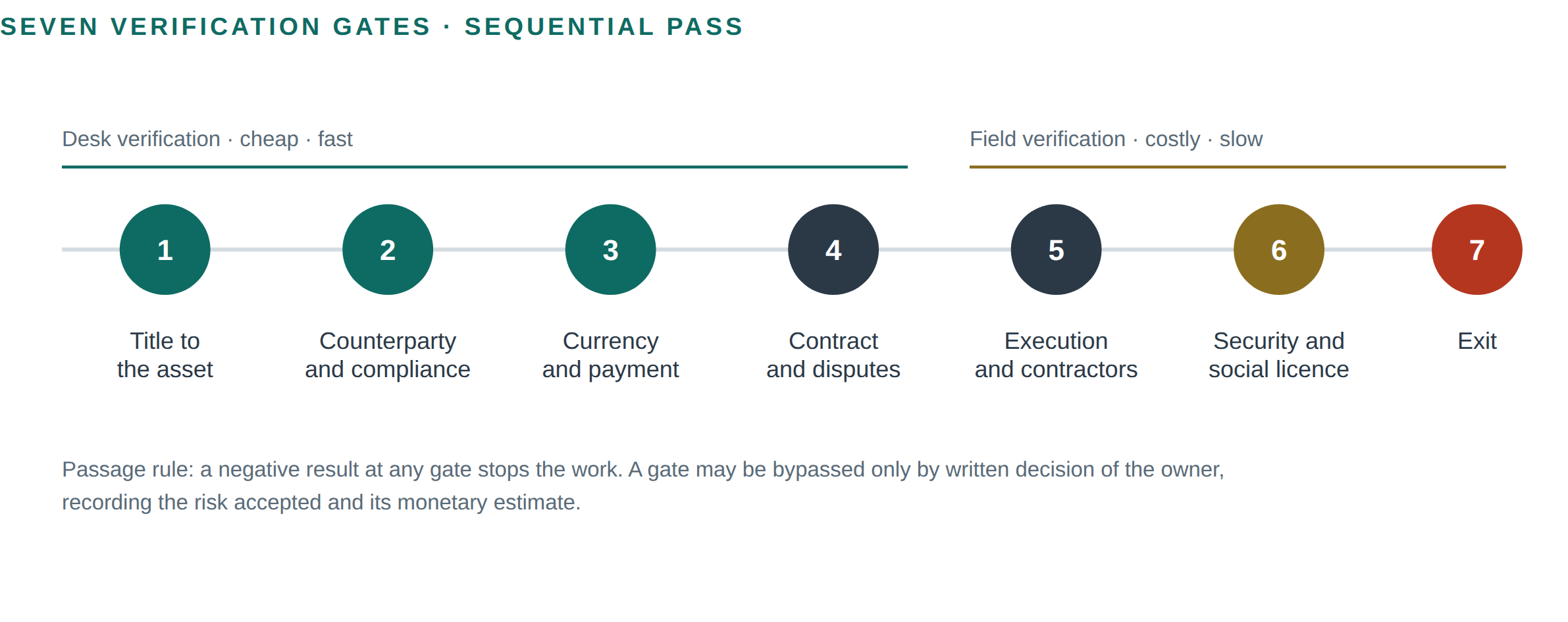
Figure 1. Consylion methodology. Gates 1–4 are documentary and take two to six weeks. Gates 5–7 require site visits, interviews with local contractors and independent verification. For preliminary planning, Consylion uses an illustrative allowance of 0.3–0.8% of investment for all seven gates; actual scope and fees depend on project size, jurisdictions and evidence quality.
03
Gate 1. Title to the asset and cost recovery
The first question is not "how large are the reserves" but "on what basis do we hold this and how do we get our money back". The form of the legal relationship allocates risk between investor and state far more powerfully than the quality of the reservoir.
TABLE 2. PRINCIPAL PETROLEUM REGIMES AND THEIR FINANCIAL LOGIC
| Regime | Who bears cost | How the investment is recovered | Principal investor risk |
|---|---|---|---|
| Concession / licence | Investor | Through product revenue after royalty and tax | Fiscal instability; retroactive changes to the regime |
| Production sharing agreement (PSA) | Investor | Cost oil, usually capped at 40–60% of annual production, then profit oil split | Dispute over cost recognition on audit; the cap stretches recovery over years |
| Technical service contract (TSC) | Investor | Reimbursement of approved costs plus a fixed remuneration fee per barrel | Delayed reimbursement; no exposure to price upside; dependence on the state company's budget |
| Pure risk service | Investor | Service fee only | No interest in reserves; full dependence on the client's payment discipline |
| Joint venture with a state company | Pro rata | Through JV dividends | Partner failure to meet cash calls; blocked decision-making |
Table 2. For a mid-market owner the fourth column is decisive. Under PSA and TSC regimes, project economics are driven not by the oil price but by the quality of cost documentation and the speed with which costs are agreed with the state partner.
RISK REALISED
Kashagan: a twenty-year argument about costs
The field has been under development since the early 2000s. First oil came in September 2013, roughly eight years behind the original plan; production stopped shortly afterwards because hydrogen sulphide corrosion required both pipelines to be replaced. Public estimates put the consortium's aggregate investment at some $55bn.
A substantial part of the dispute concerns not engineering but cost recognition. The Republic of Kazakhstan pursued arbitration over costs and, according to Bloomberg, raised its claims in 2024 to more than $150bn, including up to $138bn for revenue from production promised to the state but not delivered. The tribunal declined the companies' application to split the case into separate parts.
What this means for verification: under a production sharing regime you are not investing in a field but in the right to submit costs for recovery. That right is worth exactly as much as the cost recognition wording, the audit procedure, the deadline for objections and the mechanism for resolving disagreements. Those are what must be verified.
Gate 1 — what to verify
The original title document (licence, agreement, concession) with every annex and subsequent amendment — not a summary and not a translation supplied by the partner.
Term, renewal conditions and grounds for early termination; who decides on termination and whether that decision is challengeable.
Minimum work programmes and expenditure commitments; penalties for non-performance.
Cost recognition wording: which categories are recoverable, the cost recovery cap, the audit procedure and timetable, the limitation period for objections.
Whether a fiscal stabilisation clause exists and how strong it really is — whether it extends to new taxes and to changes in administrative practice.
Local content requirements: percentage, method of demonstration, penalties.
The history of previous holders of the title and the reasons it changed hands.
Outstanding regulatory orders, environmental obligations and decommissioning liabilities, with a quantified estimate.
KILL CRITERIA — GATE 1
Original title documents, annexes or amendments are unavailable or materially inconsistent.
Cost-recovery rules lack audit procedure, deadlines or limits on retrospective objections and cannot be corrected before signature.
Material environmental or decommissioning liabilities remain undisclosed or unallocated.
04
Gate 2. Counterparty, beneficiaries and compliance
This is the only gate where an error creates liability for the investor rather than merely a loss. The enforcement record of recent years in the commodity sector leaves little room for interpretation.
TABLE 3. PUBLICLY DISCLOSED RESOLUTIONS IN COMMODITY TRADING
| Company | Year | Amount | Substance |
|---|---|---|---|
| Glencore International A.G. and affiliates | 2022 | > $1.1bn | Guilty pleas to foreign bribery and to a commodity price manipulation scheme; coordinated resolution with authorities in the US, UK and Brazil; independent monitor for three years |
| Gunvor S.A. | 2024 | > $661m | Guilty plea to conspiracy to violate US anti-bribery law in connection with obtaining business from Ecuador's state oil company |
| Trafigura | 2024 | $127m | Admission of bribery of officials of the Brazilian state company between 2003 and 2014; separate settlement with the Brazilian authorities in 2025 |
| Vitol Inc. | 2020 | deferred prosecution agreement | Resolution with the US Department of Justice and the commodities regulator over bribery and manipulation |
Table 3. Based on official enforcement releases and specialist reviews [7]–[11]. The common thread across all of them: payments were routed through intermediaries and consultants, documented as fictitious service invoices, and passed through special purpose vehicles. That structure — "a local consultant with exclusive access" — is precisely what Gate 2 exists to test.
For a mid-market owner the conclusion is entirely practical: the presence in a deal structure of an intermediary whose fee bears no relation to services actually rendered is a kill criterion in its own right. Not because it is unlawful by default, but because the burden of proving otherwise will later fall on you, not on the regulator.
A note on oil and products trading: documentary risk
In trading, screening the counterparty without verifying the goods and the title documents is pointless. Two publicly examined cases make this unusually clear.
RISK REALISED
Trafigura: the cargo that was not there
In February 2023 Trafigura announced a $577m provision against losses which it attributed to systematic fraud. The company had financed shipments described as LME-grade nickel; on inspection the containers held low-value material — stainless steel, iron briquettes and similar. Purchases totalled around $500m, while disposal of what had actually been received realised under $10m.
On 30 January 2026 the English High Court ruled in Trafigura's favour, finding that the scheme had been orchestrated by the defendant. According to the proceedings, it was sustained by thousands of falsified documents — bills of lading, certificates of analysis and insurance documents; the court separately noted the role of a Singapore freight forwarder through which duplicate bills of lading were issued.
What this means: a signature and stamp on a bill of lading confirm neither the existence of the cargo nor its quality. What does confirm them is independent inspection at an agreed point, direct confirmation of the bill's authenticity from the carrier, and control of the custody chain. That verification costs a fraction of one percent of the parcel value.
RISK REALISED
Hin Leong: when the collateral has been sold twice
In April 2020 one of Singapore's largest independent oil traders filed for protection from creditors. In court filings the founder admitted concealing around $800m of futures trading losses and that oil pledged as collateral for bank lending had been sold. Debt stood at roughly $3.85bn owed to more than twenty banks. In 2024 the founder was convicted of cheating a bank and of abetting forgery.
What this means: audited accounts showing positive equity a few months before collapse are not a risk control. The controls that work are independent verification of inventory and encumbrances: confirmation of balances directly from the terminal, a register of pledges, and reconciliation of volumes between the storage operator and the borrower.
Gate 2 — what to verify
Ultimate beneficial owners of the counterparty and of every intermediate entity, documented rather than asserted.
Sanctions screening under all applicable regimes (EU, US, UK, UN, national) across entities, beneficiaries, management, vessels and correspondent banks, repeated before every payment.
Public record: litigation, arbitration, regulatory action and investigations involving the counterparty and its beneficiaries over ten years.
Every intermediary, agent and consultant in the structure: what they do, how the fee was set, and whether documented work product exists.
Financial standing of the counterparty: not only accounts, but confirmation of banking lines, pledge structure and cross-obligations.
For trading: independent cargo inspection, direct confirmation of bill of lading authenticity from the carrier, verification that no duplicates exist, and confirmation of stock balances directly from the terminal.
An anti-corruption policy applicable to the project, with staff training and a reporting channel.
Screening of settlement banks for correspondent restrictions — a transaction may be lawful yet unsettleable.
KILL CRITERIA — GATE 2
Ultimate beneficial ownership is not fully evidenced.
An intermediary's fee depends on obtaining a permit, award or government decision without verifiable services.
Sanctions screening identifies a bank, beneficiary, vessel or payment route that cannot lawfully settle.
05
Gate 3. Currency, repatriation and payment discipline
The most underestimated part of international due diligence. Profit reported in the accounts and cash received by the shareholder are separated by three barriers: payment terms, availability of foreign currency, and the right to remit.
RISK THAT WAS RESOLVED
Egypt: how an FX shortage becomes $6.1bn of arrears
As at 30 June 2024, Egypt's arrears to international oil and gas companies stood at about $6.1bn. The publicly stated cause was a shortage of foreign currency that prevented the central bank from servicing dollar-denominated obligations. The consequences were not only financial: companies cut capital spending and deferred drilling and exploration, which reduced production and increased the country's import requirement.
From mid-2024 the government executed a repayment plan: by January 2026 roughly $5bn had been paid; by December 2025 the balance had fallen to around $1.3bn; and on 10 June 2026 the petroleum ministry announced full settlement. It was separately emphasised that current monthly invoices were being met on time alongside the repayment of accumulated debt — so no new arrears were created.
What this means: the case is instructive in both directions. It shows the cost of ignoring the currency regime on entry, and equally that payment discipline is recoverable and is a measurable signal for investors. When assessing a country, look not at statements but at two metrics: the actual average payment period across the sector over the past 24 months, and the trend in accumulated arrears.
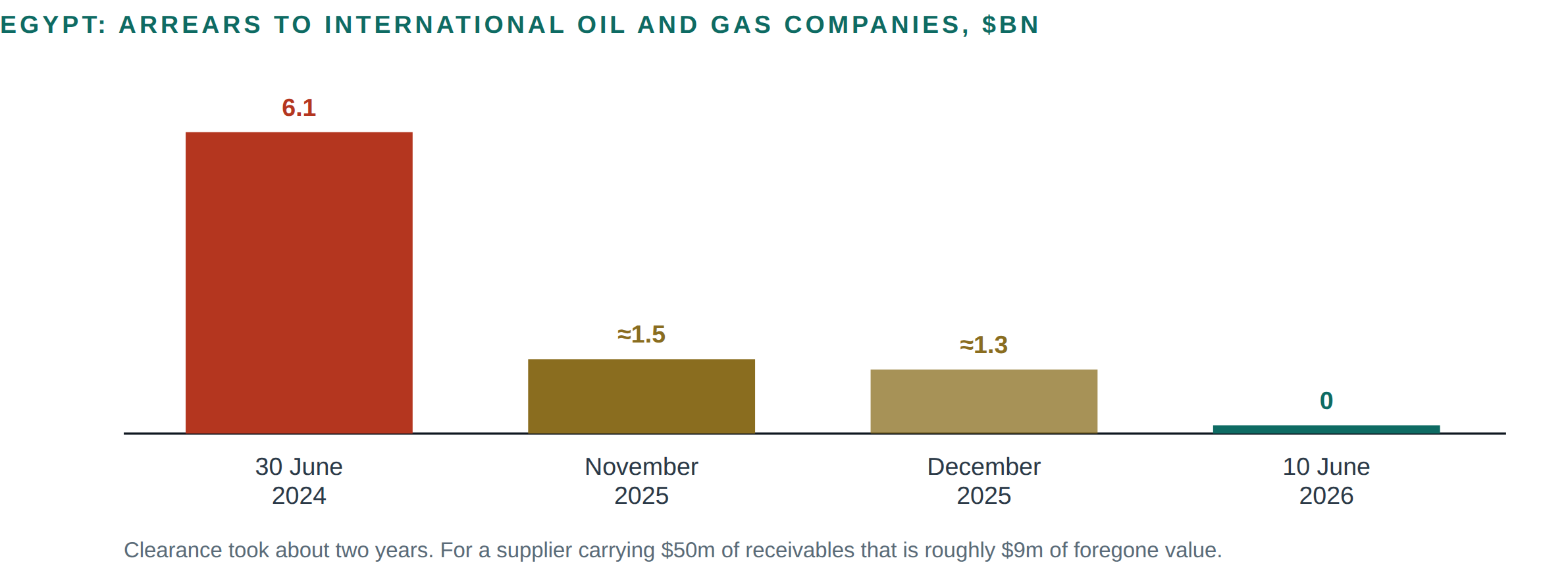
Figure 2. Based on official statements from Egypt's Ministry of Petroleum and Mineral Resources and trade press [12]–[14]. The foregone-value calculation is illustrative: $50m of average receivables at a 12% weighted average cost of capital over approximately 18 months.
Gate 3 — what to verify
Contract currency, actual settlement currency, and the mechanism for setting the rate where they differ.
Exchange control regime: whether conversion requires approval, whether an application queue exists, and its actual clearing time over the past 12 months.
Rules on repatriation of profit and capital: caps, timing, mandatory surrender of proceeds.
Withholding tax on dividends, interest and royalties; whether a double tax treaty exists between the host country and the holding jurisdiction, and whether it is applied in practice.
Transfer pricing rules and documentation requirements for intra-group transactions.
The client's or state company's actual payment record: not the stated terms but the real average payment period over 24 months, corroborated by other contractors.
Whether settlement is possible through an account outside the host country, an escrow mechanism, or direct routing of export proceeds offshore.
Correspondent bank restrictions and sanctions compliance requirements across the payment chain.
KILL CRITERIA — GATE 3
No credible legal and operational route exists for conversion and repatriation.
A state or strategic client has material arrears and the contract lacks secured payment mechanics.
Settlement depends on a bank or correspondent chain that will not confirm its ability to process the transaction.
06
Gate 4. Contract, governing law and dispute resolution
The classic mid-market error is treating the arbitration clause as boilerplate to be agreed last. In practice it is the one provision that operates precisely when everything else has stopped operating.
Four things must be verified, and they are not the same thing.
Governing substantive law. Whose law determines the content of the obligations. English law is widespread in commodity contracts not by tradition but because it is predictable on assignment, security and damages.
Dispute forum. Arbitration or state court, and under which institution: LCIA, ICC, SCC, SIAC, DIAC, HKIAC. Each has its own timelines, costs and practice on interim relief.
Seat of arbitration. The legal seat determines which country's courts may set the award aside. It is not the same as the venue where hearings are held.
Enforceability. Whether the country where the debtor's assets sit is a party to the 1958 New York Convention on the Recognition and Enforcement of Foreign Arbitral Awards, and how local courts apply it in practice.
An award that cannot be enforced where the debtor's assets are located is worth exactly what it cost to obtain — and no more.
A separate layer of protection is intergovernmental investment protection. Where a bilateral investment treaty is in force between the host country and the jurisdiction through which the investment is structured, the investor gains a direct right to arbitrate against the state in cases of expropriation or breach of fair and equitable treatment. The choice of holding jurisdiction should therefore be driven not only by tax but by the treaty network.
Gate 4 — what to verify
Governing law, forum, seat, language and number of arbitrators — all four parameters, not merely "arbitration".
Whether the country holding the debtor's assets is a New York Convention party, and local practice on enforcing foreign awards.
Whether a bilateral investment treaty is in force between the host country and the holding jurisdiction, and the conditions of access to investment arbitration.
A waiver of sovereign immunity from execution by any state counterparty.
The force majeure definition: what exactly is included, who bears the costs of a suspension period, and the maximum duration before a termination right arises.
The mechanism for scope and price change; the procedure and deadlines for claims; the consequences of missing them.
Limitation of liability, exclusion of consequential loss, and the level and accrual of delay damages.
Security: bank guarantees, letters of credit, parent company guarantees — with verification of the guarantor's solvency, not merely the existence of the document.
07
Gate 5. Execution: contractors, logistics, local content
This gate determines what the project will actually cost. Three questions decide almost everything.
First, the contracting model. A lump-sum turnkey contract looks to a client like a transfer of risk. In practice it transfers risk only for as long as the contractor remains solvent. Petrofac reported a $505m net loss attributable to shareholders for 2023, including an incremental loss of about $190m on the Thai Oil Clean Fuels project; other legacy portfolio losses and write-downs also contributed. The subsequent restructuring contemplated conversion of roughly $772m of debt into equity. Thai Oil terminated the relevant consortium contract in April 2025; the listed holding company entered administration in October 2025, while operating businesses continued and were sold in parts. The client did not obtain complete protection from the fixed-price structure: it obtained a stopped scope and a dispute.
Second, the real depth of the local contractor market. Local content requirements are rarely economically neutral. Where no qualified local supplier exists, the requirement becomes a 5–15% premium on capital cost and an extension of the schedule.
Third, logistics and customs. For projects in remote regions and in countries with burdensome customs procedures, the delivery time of critical equipment is the leading schedule driver, not the construction work that follows it.
Gate 5 — what to verify
The rationale for the contracting model and an assessment of the contractor's solvency against the risk it is being asked to carry.
For preliminary screening, Consylion flags a contract above 25% of the contractor's annual revenue or backlog for explicit stress testing. The threshold is a risk flag, not an automatic rejection.
An independent should-cost estimate before tender; rejection of abnormally low bids as policy rather than exception.
Availability of qualified local contractors for each critical scope; a quantified local content premium.
Customs procedures, timelines and temporary import regimes for equipment; project exemptions and how they are evidenced.
A logistics plan identifying critical points: ports, transhipment, seasonal constraints, road condition, abnormal load permits.
Availability of qualified personnel, visa and permit procedures, and local hiring requirements.
Power, water and communications availability at site, and the cost of building what is missing.
08
Gate 6. Security and social licence
The only gate that cannot be verified remotely, and the only one where a risk event is measured in years rather than percentages.
RISK REALISED
Mozambique LNG: four years of suspension and $4.5bn of additional cost
A project of around $20bn, which in July 2020 raised $14.9bn of project finance from 31 financial institutions, was halted in April 2021 after a militant attack on the town of Palma near the site. The operator declared force majeure.
The recovery timeline is instructive. The operator formally lifted force majeure on 7 November 2025 and announced the full restart of onshore and offshore activities on 29 January 2026. The original financing group comprised 31 institutions. By 1 December 2025 lenders representing about 90% of external financing had reconfirmed; the partners said they would replace the share of two export credit agencies with equity. The government granted a 4.5-year concession extension and requested an independent audit of suspension-period costs. The operator described a pre-suspension budget of about $15.5bn and an overall cost of about $20.5bn including roughly $4.5bn attributed to the suspension. First LNG is expected in 2029, with the project assessed at around 40% complete at restart.
What this means for verification: three separate lessons. First, site security is a schedule parameter, and schedule is cost of capital. Second, the more lenders in the structure, the slower decisions are taken in a crisis; the number of consenting parties must be assessed in advance. Third, the $4.5bn of suspension-period cost arose with no construction activity. Site maintenance, security, personnel and debt service continue while a project stands still.
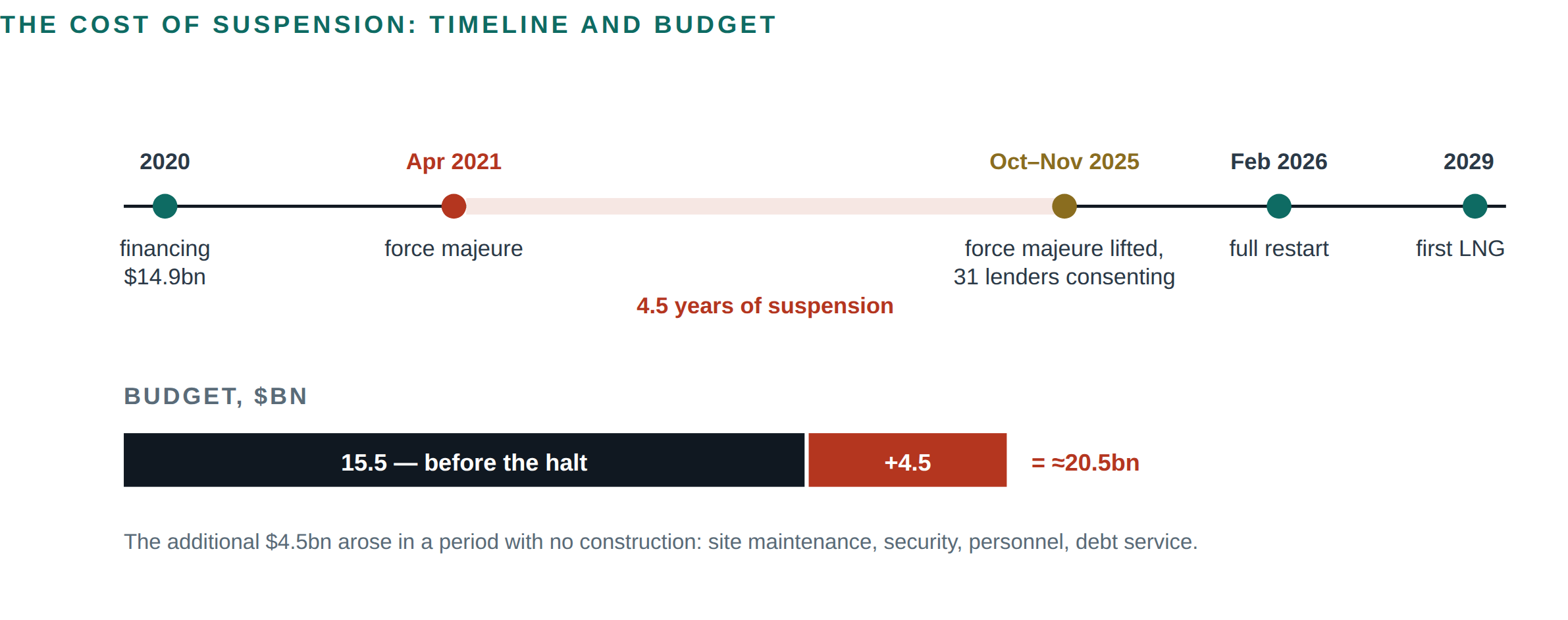
Figure 3. Based on operator statements and trade press [15]–[18]. For a mid-market owner the proportion matters more than the absolute figures: the suspension added 29% to the budget at zero physical progress.
Gate 6 — what to verify
Independent security assessment across the whole logistics corridor, not only the site; incident trend over 36 months.
Who actually provides security: state forces, private providers, foreign contingents; the legal basis for their presence and the term of the relevant agreements.
Human rights and reputational exposure connected with security provision, and its consequences for access to finance.
Relations with local communities: resettlement, compensation, employment, and whether a functioning grievance mechanism exists.
Lender and export credit agency requirements on environmental and social standards; the number of parties whose consent will be required for any material change.
Personnel evacuation plan, political risk and war risk insurance, with policy limits and exclusions.
A suspension scenario: what a month of full stoppage costs and who bears it under the contract.
Whether and how the term of the title can be extended on the occurrence of force majeure.
09
Gate 7. Exit
The gate most investment committees never reach. Yet it is what determines whether the commitment is an investment or an obligation.
Gate 7 — what to verify
Whether an interest may be transferred: is state or partner consent required, within what period must it be given, and may it be withheld without reasons.
Partner pre-emption rights and the pricing mechanism on their exercise.
Put and call options, tag-along and drag-along rights, and the deadlock resolution mechanism.
Tax consequences of exit: capital gains tax, indirect transfer rules, notification requirements.
Obligations surviving exit: decommissioning, environmental liabilities, warranties and indemnities.
The existence of potential buyers: who could realistically acquire this asset and on what terms.
The forced exit scenario: the procedure on revocation of title, change of ownership regime or expropriation; whether political risk insurance is in place.
The possibility of partial exit through sale of an equity interest while retaining operatorship, or vice versa.
10
The financial test: calculating the return honestly
All seven gates converge on a single point: the required return. The error we see most often is that the team calculates a project IRR in local terms and compares it with a hurdle set for the domestic market. That is wrong twice over: the hurdle should be higher and the return lower.
Constructing the hurdle rate
TABLE 4. BUILDING THE REQUIRED RETURN ON EQUITY
| Component | Value | Comment |
|---|---|---|
| Risk-free rate | 4.2% | Long-dated government bonds in the investment currency |
| Equity risk premium | 5.0% | Developed market baseline |
| Country risk premium | 4.0% | Emerging market range typically 1.5–9.0% depending on sovereign rating and spread |
| Execution premium | 2.3% | New jurisdiction, no operating history for the investor, greenfield |
| Required return on equity | 15.5% | Approval threshold |
Table 4. Illustrative Consylion model. The country premium must be derived from a methodology fixed in the investment policy in advance, not selected to suit a particular transaction. Tuning the premium to produce the desired answer is the most common way to approve a project that should not have been approved.
The bridge from gross project return to owner return
Now the second half of the calculation. Take an energy-sector production project: $20m of capital expenditure and a calculated gross IRR in local terms of 22.0%. Below is what survives passage through all seven gates.
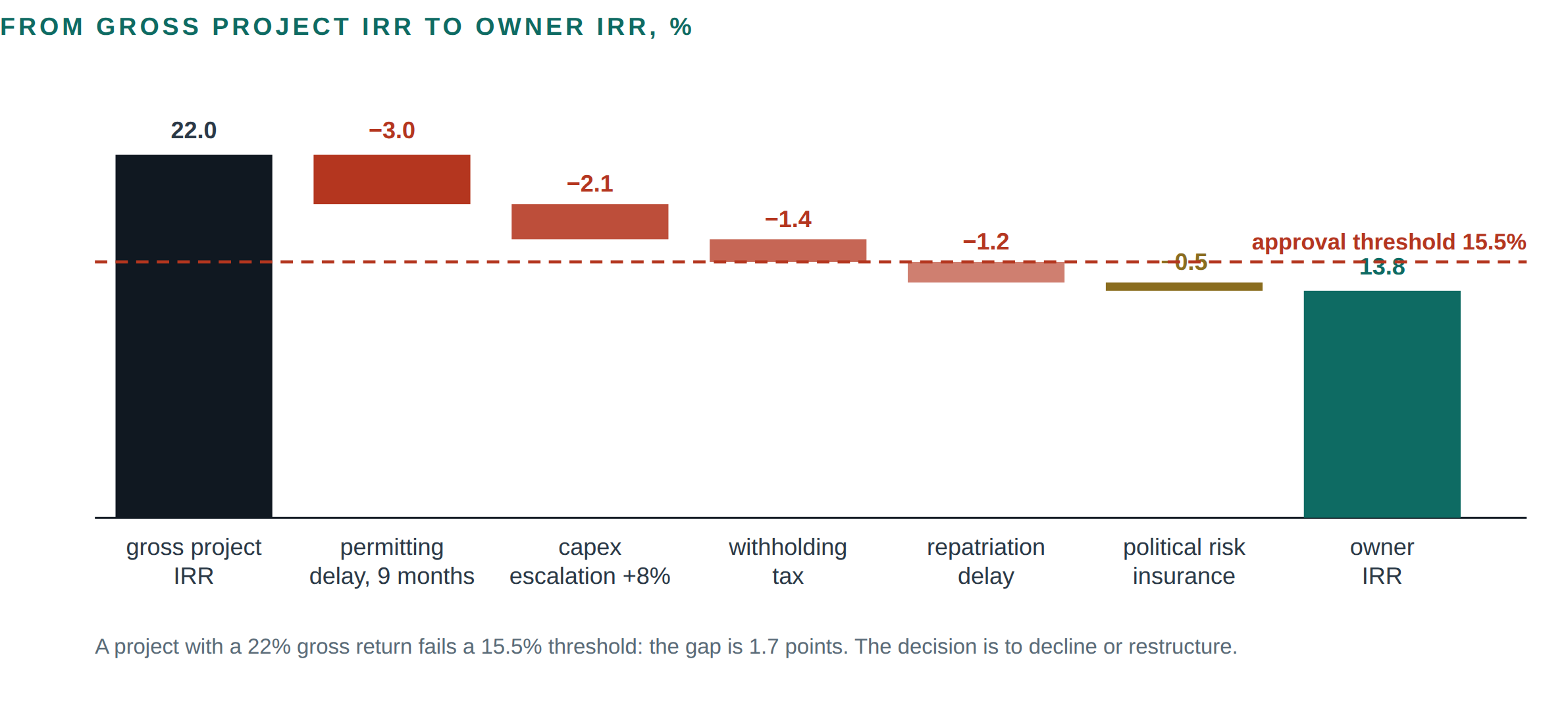
Figure 4. Illustrative Consylion model. Each deduction maps to a specific gate: permitting delay to Gate 1; capex escalation from local content and logistics to Gate 5; withholding tax and repatriation delay to Gate 3; the insurance premium to Gate 6. The calculation is a methodological illustration and does not relate to any specific project.
This chart is the single tool we most often recommend embedding in investment committee practice. It makes visible what usually falls between departments: engineering owns the first column, legal owns the third and fourth, treasury owns the fifth, security owns the sixth. Nobody owns the last one. And it is the only one that matters to a shareholder.
11
Kill criteria: when not to approve regardless of return
TABLE 5. KILL CRITERIA AND PERMISSIBLE MITIGANTS
| Kill criterion | Why it is absolute | Possible mitigant |
|---|---|---|
| Counterparty beneficiaries not fully disclosed | Sanctions and anti-corruption control is impossible; liability shifts to the investor | None. Disclosure only |
| Intermediary fee contingent on obtaining a permit | A direct indicator of corruption risk as regulators construe it | Remove the intermediary; contract directly |
| Cost recognition has no procedure or deadlines | Recovery of the investment is unprotected | Agree a cost audit protocol before signature |
| An award would be unenforceable where the assets sit | Legal protection is nominal | Security outside the jurisdiction: escrow, first-class bank guarantee, pledge of export proceeds |
| No right to transfer an interest without unreasoned consent | The asset is illiquid for the whole project life | Negotiate a right to transfer to affiliates; a put option on the partner |
| One contract exceeds 30% of the contractor's annual revenue and the contractor cannot evidence financing, guarantees or downside capacity | Insolvency risk at the first deviation | Split the scope; parent guarantee; direct step-in rights |
| Security environment not independently assessed | The probability of a multi-year suspension cannot be estimated | Independent assessment; political risk insurance; staged commitment |
| Hurdle rate tuned to the answer | Investment discipline does not exist | Approve the hurdle methodology before transactions are considered |
Table 5. We recommend that the owner approve the kill criteria before specific projects are considered. A list drawn up while an attractive deal is on the table is always shorter than it needs to be.
12
Structuring: reducing residual risk
Where a project has passed the seven gates but residual risk remains high, the next step is not refusal but restructuring. The instruments below are accessible to mid-market businesses; indicative costs are shown.
TABLE 6. RISK MITIGATION INSTRUMENTS
| Risk | Instrument | Indicative cost | What remains uncovered |
|---|---|---|---|
| Expropriation, inconvertibility, political violence | Political risk insurance (multilateral agencies and private market) | 0.5–1.5% of cover per year | Commercial losses; gradual erosion of terms without formal expropriation |
| Non-payment by a state client | Offshore escrow; direct routing of export proceeds; letter of credit confirmed by a first-class bank | 0.1–0.5% of turnover | Refusal to lift; changes to the export regime |
| Shortage of long-term finance | Export credit agency covered lending | 3–8% of the loan as an upfront premium | Agency requirements on procurement and E&S standards; longer approval timelines |
| Currency risk | Hedging, hard-currency pricing, natural hedging through local costs | driven by the interest differential | Inconvertibility risk (hedging does not protect against it) |
| Contractor default | Performance bond, parent company guarantee, direct step-in rights | 1–3% of contract value | Time to replace the contractor; repricing on re-award |
| Legal exposure | Holding in a jurisdiction with a live investment treaty; arbitration clause seated in a neutral jurisdiction | legal costs | Proceedings lasting 3–6 years; cost of the process |
| Front-end uncertainty | Staged commitment: entry option, limited first phase, defined checkpoints | possible premium on entry price | Loss of some economies of scale; risk of terms changing between phases |
Table 6. Costs are indicative and given for preliminary assessment; actual terms are set case by case. For early planning, Consylion uses an illustrative total structuring allowance of 1.5–3.5% of investment for a mid-sized project. This is a modelling assumption, not a market quote, and should be included before return is calculated.
13
After approval: what to monitor monthly
Approval is not the end of verification but its beginning. The conditions on which a project was approved change, and the owner's task is to notice before the change becomes irreversible.
TABLE 7. INTERNATIONAL PROJECT MONITORING PANEL
| Indicator | What it shows | Frequency | Intervention trigger |
|---|---|---|---|
| Actual client payment period, days | Counterparty and country payment discipline | Monthly | Increase above 20% in a quarter |
| Conversion and remittance time, days | State of the currency regime | Monthly | Statutory period exceeded twice consecutively |
| Share of costs admitted for recovery | Whether the recovery mechanism works | Quarterly | Below 90% of costs submitted |
| Open claims and variations | Accumulation of hidden liability | Monthly | Above 5% of contract value |
| Regional security incident index | Probability of suspension | Monthly | Any incident within the logistics corridor |
| Regulatory changes | Fiscal and regulatory stability | Monthly | Any change affecting the project |
| Counterparty credit profile | Non-payment risk | Quarterly | Downgrade or rising cost of borrowing |
| Recalculated owner IRR | Whether actual conditions match those approved | Quarterly | Falls below the approval threshold |
| Sanctions compliance status | Change in counterparty and bank status | Before every payment | Any screening hit |
| Cost of a month of stoppage | Readiness for a suspension scenario | Quarterly | No calculation exists |
Table 7. The last line is not a metric in the ordinary sense. It tests whether an answer exists to the question: if work had to stop tomorrow, what does that cost per month and who pays for it. The absence of an answer is itself a management defect.
14
Conclusion
An international project differs from a domestic one not in complexity but in irreversibility. At home an owner can correct almost any mistake: renegotiate, replace the contractor, go to a familiar court, reach an accommodation. Abroad, the set of available actions narrows to those provided for in the documents at the outset. Everything not provided for must either be accepted or lost.
Three conclusions follow, which we treat as a practical standard.
First. Verify reversibility, not return. The central question for an investment committee is not "how much will we make" but "which of our actions remain available if the scenario does not hold". The right to submit costs for recovery; the right to transfer an interest; the right to an enforceable award; the right to suspend without penalty; the right to evacuate people. A project with few available actions is high-risk whatever the model shows. Kashagan, Mozambique and the Egyptian arrears are three different stories with one shared property: in all three the investor stayed in because leaving cost more than staying.
Second. The calculation must reach the shareholder's pocket. The 8.2-point gap between gross project return and owner return in our model is not a pessimistic assumption; it is ordinary arithmetic of withholding tax, conversion delay, local content premium and insurance. A company that decides on gross returns systematically approves value-destroying projects and does not understand why reported profit fails to become dividends. The bridge from gross IRR to owner IRR belongs in every investment memorandum — on one page, with the owner of each deduction named.
Third. The cost of verification is not comparable to the cost of error. A full seven-gate review for a mid-sized project can be planned at a fraction of one percent of investment and six to twelve weeks, subject to scope. The case record shows that losses are not explained by market misreading alone: gaps in verification, control or risk allocation can lock investors into years of delay, large claims, impaired cargo or costly restructuring.
PRACTICAL RULE
We state that firmly on purpose. Deadline pressure — "we must sign by month end or the asset goes elsewhere" — is one of the clearest warning signs of a problem transaction. If an opportunity cannot tolerate a short, defined verification period, the deadline itself should be treated as a risk signal. Verification deferred for weeks can create consequences measured in years.
References
EY. Oil and gas megaproject overruns to cost industry more than US$500b (regional data). prnewswire.com
EY. Spotlight on oil and gas megaprojects (full study, PDF). aegex.com
Offshore Technology. Kashagan Offshore Oil Field: project overview. offshore-technology.com
Bloomberg. Kazakhstan's Compensation Claims Against Kashagan Oil Firms Jump to $150 Billion, 17 April 2024. bloomberg.com
Qazinform. Kashagan oil field dispute: Kazakhstan raises claims to $160 billion. qazinform.com
RFE/RL. Kazakhstan's Kashagan Starts Up… Again (pipeline replacement, schedule). rferl.org
U.S. Department of Justice. Glencore Entered Guilty Pleas to Foreign Bribery and Market Manipulation Schemes, 24 May 2022. justice.gov
Glencore. Glencore Reaches Coordinated Resolutions with US, UK and Brazilian Authorities (company statement). glencore.com
U.S. Department of Justice. Commodities Trading Company Will Pay Over $661M to Resolve Foreign Bribery Case (Gunvor). justice.gov
U.S. Department of Justice. Swiss Commodities Trading Company Pleads Guilty to Foreign Bribery Scheme (Trafigura), 28 March 2024. justice.gov
U.S. Department of Justice. Vitol Inc. Agrees to Pay Over $135 Million to Resolve Foreign Bribery Case, 3 December 2020. justice.gov
Egypt State Information Service. Egypt clears $6.1 billion in oil, gas arrears to foreign partners, 10 June 2026. sis.gov.eg
Energy Connects. Egypt clears all arrears for foreign oil and gas companies, June 2026. energyconnects.com
OilPrice.com. Egypt Pays Its Energy Debts — but the Real Test Is Just Beginning (origins of the arrears). oilprice.com
TotalEnergies. Mozambique LNG announces the full restart of all its activities onshore and offshore in Mozambique (company statement). totalenergies.com
JPT (SPE). TotalEnergies Lifts Force Majeure on Mozambique LNG (budget and suspension-period costs). jpt.spe.org
TotalEnergies. Clarification on Mozambique LNG project financing, 1 December 2025 (around 90% of lenders reconfirmed; two ECAs to be replaced by partner equity). totalenergies.com
Lusa / Club of Mozambique. Mozambique agrees to reinstatement of the four-and-a-half-year force-majeure period for the LNG concession. clubofmozambique.com
Hill Dickinson. Commodity trader successful in fraudulent nickel trade claims — review of Trafigura Pte Ltd & anor v Prateek Gupta & ors [2026] EWHC 159 (Comm). hilldickinson.com
Global Trade Review. In-depth: Trafigura wins blockbuster Gupta fraud claim. gtreview.com
Global Finance. Hin Leong's Collapse Sends Shockwaves Through Singapore. gfmag.com
Global Trade Review. Analysis: Hin Leong's "vicious cycle" of trade finance fraud. gtreview.com
Petrofac. Results for the year ended 31 December 2023 (group loss and Thai Oil incremental loss). petrofac.com
London Stock Exchange. Petrofac announces comprehensive financial restructuring and debt-to-equity conversion. londonstockexchange.com
Petrofac. Cancellation of listing and trading after appointment of administrators, 28 October 2025. petrofac.com
Petrofac. Completion of sale of Petrofac Emirates, 26 May 2026. petrofac.com
Kaohoon International. Thai Oil terminates UJV contract, 25 April 2025. kaohooninternational.com
UNCITRAL. Convention on the Recognition and Enforcement of Foreign Arbitral Awards (New York, 1958): official status and text. uncitral.un.org
UNCTAD. International Investment Agreements Navigator. investmentpolicy.unctad.org
Sources and links were reviewed as at the data cut-off of 26 July 2026. Information is presented as disclosed in the public record and may later be revised, appealed or superseded. Availability of third-party pages is not guaranteed.
Legal notice and disclaimer
Informational purpose. This material has been prepared by Consylion for information and educational purposes only. It does not constitute investment, financial, tax, accounting, legal or other professional advice and must not be relied upon as the sole basis for any management or investment decision.
No offer. Nothing here constitutes an offer, an invitation to make an offer, or a recommendation to enter into any transaction in securities, equity interests, commodities or derivatives, nor does it constitute the promotion of financial products.
Not legal advice. The sections addressing petroleum regimes, governing law, arbitration, sanctions and anti-corruption regulation are general in nature and do not take account of the circumstances of any particular transaction. Applicable law and practice vary by jurisdiction and change over time. Advice from qualified legal and tax advisers in the relevant jurisdictions must be obtained before any decision is taken.
Sanctions compliance. Nothing in this material may be construed as a recommendation to undertake, or assistance in undertaking, any transaction restricted under the sanctions regime of any jurisdiction. Responsibility for compliance with applicable sanctions, export control and anti-corruption requirements rests solely with the party undertaking the transaction.
Calculations and models. All financial models, tables and scenarios described as illustrative are simplified methodological examples built on assumed inputs. They do not reflect the results of any specific company or project, are not forecasts, and guarantee no outcome. The indicative costs shown for risk mitigation instruments are given for preliminary assessment only; actual terms are set case by case.
Sources and accuracy. Information about projects, companies, proceedings and resolutions is based on publicly available publications listed under References, as at the date of preparation. Consylion has not independently verified that information and gives no representation or warranty as to its completeness, accuracy or currency.
Proceedings and allegations. References to claims, allegations, investigations and proceedings are limited to the public record cited. They do not imply liability beyond a final judgment, guilty plea or formal resolution where one exists. Ongoing matters may be contested, appealed, revised or discontinued.
Third-party references. Names of companies, projects, public authorities and trade marks are used solely for fair informational and analytical comment on publicly available facts, including officially disclosed decisions of courts and enforcement agencies. Such references imply no association, affiliation, endorsement or sponsorship and assert nothing beyond what is disclosed in the cited sources. All trade marks belong to their respective owners.
Limitation of liability. To the fullest extent permitted by applicable law, Consylion, its personnel and affiliates accept no liability for loss arising from reliance on this material. Nothing in this notice excludes or limits liability that cannot lawfully be excluded or limited.
Copyright. © 2026 Consylion FZ-LLC. All rights reserved. This is an original analytical work. Short quotation is permitted with clear attribution to Consylion and an active link to the original Consylion publication. Full or substantial reproduction, translation or commercial reuse requires prior written consent.
Consylion — advisory in energy, investment and corporate finance: structuring international projects, project finance, treasury, investment due diligence and capital programme control across oil and gas, power and infrastructure.
To run the seven-gate review on your project: consylion.com